Compass Instruments · FOUNDATION™
Mental Fitness™ Team Reading
Name the team, name the coach reading it with them, and invite up to 15 people. Each person takes the two licensed instruments, enters their own score and top three patterns, and receives their own reading. You build the team sheet from what comes back.
Storyboard · Six acts · Executive team
High-performance teaming is not a mood. It is a designed, drawn and governed structure.
Read the six acts in order. One composite executive team carries the whole story — from a civil meeting where nothing moves, to a leadership system that can face its own economic truth and architect the next phase of growth.
Where it shows
The calendar
Decisions relitigated, dates moved, escalations rising — before any number moves.
Where it is read
FOUNDATION™
Grouping #20. Team behaviour determines whether the architecture above it can be operated honestly.
Where it closes
ARC™
Assess · Refine · Commit. Every claim carries an owner, a date and a review.
Act I
The room
The meeting is civil. The decision is not made.
Nine capable executives, one agenda, no argument. Everyone leaves aligned and nothing moves. The leader concludes the team needs to be pushed harder.
The team in the story
The operating team of a mid-market manufacturer, four quarters into a growth plan that keeps slipping a quarter at a time.
Compass read · Symptom, not cause. A team that cannot disagree in the room will disagree in the hallway.
Act II
The tell
The real debate has moved somewhere you cannot govern.
Dates drift. Decisions are relitigated by email. Corrections route through the leader instead of between peers. Local wins accumulate while the enterprise result stalls.
The team in the story
Two functions are quietly optimising their own scoreboards. Neither is acting in bad faith; both are acting rationally inside the design they inherited.
Compass read · These are the five tiers of the team's behavioural contract failing in sequence — from the bottom up.
Act III
The diagnosis
Before a team fails to disclose, a nervous system decides disclosure is unsafe.
Under load, threat circuitry fires first and the Judge narrates. Its accomplice Saboteurs borrow the urgency, and the story is experienced as fact. Deliberate judgment, perspective-taking and empathy are the first capabilities to narrow — precisely what the room needs most.
The team in the story
Read individually: Controller, Avoider and Hyper-Achiever dominate the team's pressure profile. Read as a system: disclosure is expensive, so nobody pays for it.
Compass read · Diagnostic grouping #20 inside FOUNDATION™. A read on the architecture — never a label on a person.
Act IV
The vocabulary
Difference has to become pace and outlook, not a verdict.
DISC does the narrow, decisive work: it lets a team name how each person moves under pressure without moralising it. That is what makes vulnerability reachable rather than aspirational — and vulnerability-based trust is the load-bearing tier.
The team in the story
The team stops calling one another difficult and starts describing tempo, risk appetite and how each person needs information delivered.
Compass read · Shared language is a precondition for the conversation, not a substitute for the system change.
Act V
The system change
Awareness is not an intervention. Something visible has to change.
Insight ships with a change to decision rights, roles, standards or cadence — recorded, owned and dated inside Compass Enterprise Architecture™. The enterprise model comes first: economic truth, the vital few, and the architecture of the next phase of growth. The instruments serve it.
The team in the story
One decision right moved, one standard written, one scoreboard made shared, one weekly cadence installed with an owner and a date.
Compass read · Closed through ARC™ — Assess · Refine · Commit. Renewal is scheduled, not hoped for.
Act VI
The result
The team becomes the instrument that can face its own economic truth.
Disagreement happens in the room. Decisions leave intact. Peers hold the standard. One scoreboard outranks status, turf and function — and the leadership team, not one leader, carries the next phase of growth.
The team in the story
The growth plan stops slipping because the constraint was the design of the room, not the effort of the people in it.
Compass read · Compass leaves business architects, not dependency. Capability transfer is the outcome of record.
Where the story is told
The six acts are worked through with an intact leadership team — and in the executive roundtable, where peers who run other enterprises test the same reading against their own.
The team in this storyboard is a composite example built from patterns seen across engagements. It is not a client case study and not a verified outcome; every detail is illustrative. Model: the Five Dysfunctions of a Team — Patrick Lencioni, Jossey-Bass (Wiley). PQ®, Positive Intelligence®, Judge, Saboteur and Sage are terms from the work of Shirzad Chamine and Positive Intelligence, LLC. DISC is a behavioural model in the Marston lineage, assessed through independent publishers' instruments. Compass Performance, Inc. is not affiliated with, nor endorsed by, any of them.
Before you invite the team
What the reading is actually measuring
A team sheet is read against the five tiers of the behavioural contract — trust, conflict, commitment, accountability, results. Those tiers explain what a team produces. Under pressure, each person's Judge and Saboteur patterns are what act on those tiers, starting with the load-bearing one: vulnerability-based trust.
This is not a wellbeing programme. A team that can hold those conversations is the instrument that lets a business face its own economic truth inside Compass Enterprise Architecture™.
Exhibit · FOUNDATION™ · Grouping 20
A high-performing team is not a mood. It is a structure — and the structure is drawn.
Read at three levels: the individual under pressure, the team's behavioural contract, and the vocabulary that makes the load-bearing tier reachable. All three are read inside Compass Enterprise Architecture™, which is what turns insight into an architected next phase of growth rather than a good session.
Order of precedence
01
Compass Enterprise Architecture™
The enterprise model comes first: economic truth, the vital few, decision rights, cadence and the architecture of the next phase of growth. The instruments serve it; it does not serve them.
02
FOUNDATION™ — where teaming sits
Mental Fitness is diagnostic grouping #20 inside FOUNDATION™. Team behaviour is read here because it determines whether the architecture above it can be operated honestly.
03
Instruments, then a system change
PQ®, the team read and DISC produce evidence, not a verdict. Every claim ships with a visible change to decision rights, roles, standards or cadence, closed through ARC™ — Assess · Refine · Commit.
CompassOS™ carries the instruments, the evidence and the record. It is the layer the work runs on — never the work itself.
Level 01 · The individual under pressure
Before a team fails to disclose, a nervous system decides disclosure is unsafe.
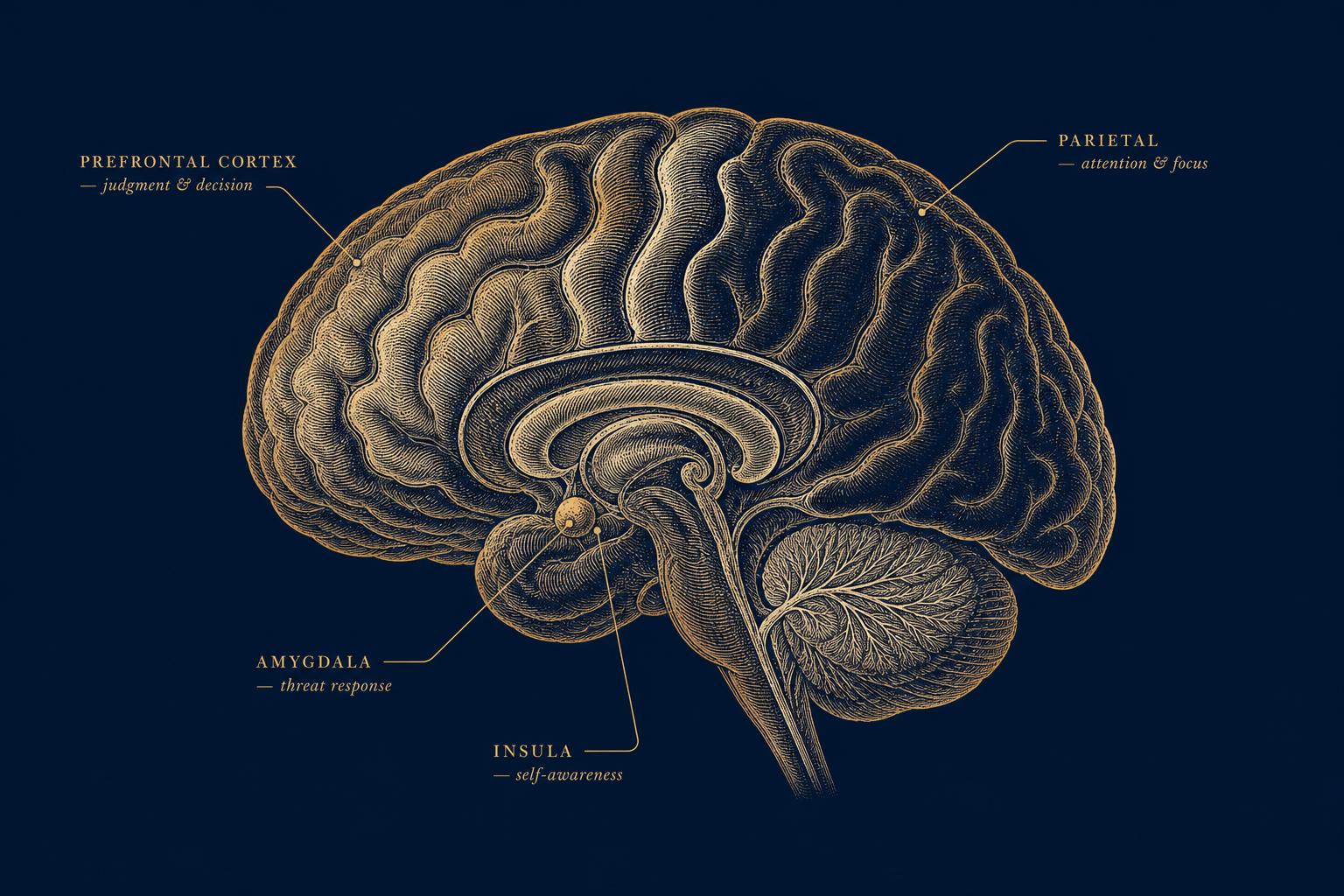
- Threat circuitry fires first. The alarm system does not distinguish a hard question in a boardroom from physical danger. The body commits before the argument is examined.
- The Judge narrates. Its accomplice Saboteurs borrow the urgency, and the story is experienced as fact rather than as one reading of the evidence.
- Sage capability narrows. Deliberate judgment, perspective-taking and empathy are the first functions to degrade — which is precisely what a team needs most at that moment.
- Training is physical. Deliberate exercise develops the human brain and its connections. Repetition strengthens the pathways used under load and lets unused ones weaken — the same principle as loading a bone once it is stabilised.
Level 02 · The team's behavioural contract
Five tiers, drawn as structure: each one carries the weight of everything above it.
01 · Vulnerability-based trust
People can say "I was wrong", "I don't know", "I need help" without cost.
The Judge makes disclosure feel dangerous. Avoider hides the issue, Controller overrides it, Hyper-Achiever performs competence instead of admitting need.
02 · Unfiltered, productive debate
The team argues about ideas in the room, not in the hallway afterwards.
Pleaser keeps the peace, Avoider changes the subject, Controller wins the exchange. The disagreement does not disappear — it relocates.
03 · Clarity and buy-in
Decisions leave the room intact, with an owner and a date.
Stickler and Hyper-Rational keep refining, Restless reopens the option set, Victim quietly withholds. Ambiguity becomes the safest position.
04 · Peer-to-peer accountability
Peers hold the standard without routing every correction through the leader.
Avoider defers the hard conversation, Pleaser protects the relationship, Hyper-Vigilant escalates instead of addressing. The standard drifts to the lowest tolerated level.
05 · Collective focus on results
One scoreboard outranks status, turf and function.
Hyper-Achiever optimises personal record, Controller protects territory, Restless chases the next thing. Local wins accumulate while the enterprise result stalls.
Level 03 · The shared vocabulary
A team cannot practise disclosure until difference stops being read as a verdict.
Style is a starting point, not an explanation and not an excuse. The plate suggests where a given team may find the first tier hardest and what the first repetition looks like — a reading worth examining together, not a classification of people.
Why it belongs in the architecture
A powerful team uses Compass Enterprise Architecture™ to face economic truth and architect the next phase of growth. Mental Fitness and the team contract are how that team stays able to do it under pressure — which is the only condition that ever matters.
Evidence from these instruments is read separately and never averaged into a single score. Where causality is unproven, the reading says so.
A team reading is only honest when each person enters their own numbers.
Each invitation explains what you are doing, links both Positive Intelligence assessments, and carries a private link where that person enters their PQ® Score and ranked top three Saboteurs. They get their own individual reading straight away, and they are told plainly that you will be able to build a team sheet listing every member.
Set the review conversation now and the invitation carries a calendar hold, so the reading has a date to land on rather than becoming another report.
Who to invite
Up to 15 people. A team reading is a working conversation, not a survey — past fifteen the room stops being readable. 3 complete readings is the minimum for a team sheet.
Mental Fitness™ is a trademark of Compass Performance, Inc. Positive Intelligence® is a trademark of the Positive Intelligence organization and Shirzad Chamine. PQ® and the Saboteur model are trademarks and the work of Shirzad Chamine and Positive Intelligence, LLC. Compass Performance, Inc. is an independent user of those instruments and claims no ownership of them.
Already have your readings on paper
If you are holding everyone's numbers already, the comparison below reads a pair or a whole team on one sheet without sending a single email.
Not sure where to start?
Three questions, and we point you to the right instrument.
Under a minute. From this page, most leaders begin with The organization.