Mental Fitness
The Team Under Pressure: Saboteurs, the Five Dysfunctions, and the Trust a Growth Decision Requires
Patrick Lencioni gave us the anatomy of a struggling team. Shirzad Chamine's work explains what is happening inside each person in the room while that anatomy forms. Read together, they stop describing behavior and start explaining it.
Written by Steve Kopecky · 11 minute read
Founder & Principal, Compass Performance, Inc.
01
The fable, read a second time
In Patrick Lencioni's leadership fable, a new chief executive inherits a Silicon Valley technology company with a strong board, funded balance sheet, better technology than its competitors — and a leadership team that cannot make a decision stick. Lencioni's diagnosis is structural: five dysfunctions stacked as a pyramid, each one resting on the tier below it. Absence of trust makes real conflict impossible. Without conflict there is no genuine commitment. Without commitment, accountability is unenforceable between peers. Without accountability, attention drifts from collective results to individual status.
Most executives who have read the book accept the model and then discover the same thing: knowing the pyramid does not change the room. The team agrees it needs more trust, schedules an offsite, and returns to the same meeting behavior within a quarter.
The reason is that the pyramid describes what a team produces, not why each individual produces it. Read the fable again with attention on the individuals rather than the team, and something more useful appears. Each character is not being difficult. Each is running a highly practiced, self-protective response to pressure — and each response is coherent, effective earlier in that person's career, and invisible to them.
The five dysfunctions are not five problems. They are the predictable output of a room full of untrained pressure responses.
02
What is actually happening inside each person
In Positive Intelligence® terms, the master pattern is the Judge: the internal voice that finds fault with yourself, with others, or with circumstances, and delivers its verdict with the felt authority of fact. The Judge recruits accomplice Saboteurs — Controller, Avoider, Pleaser, Hyper-Achiever, Hyper-Rational, Hyper-Vigilant, Restless, Stickler, Victim — each of which was useful at some point and each of which now runs automatically under load.
That mechanism is physical, not attitudinal. Threat circuitry fires before appraisal completes; attention is pulled toward the perceived threat; and evidence suggests prefrontally-dependent capability — working memory, flexible reasoning, perspective-taking — degrades under acute stress while habitual responses strengthen (Arnsten, Nature Reviews Neuroscience, 2009). The executive is not choosing to withhold the objection. The capability required to voice it well is temporarily narrowed, and the practiced response takes the wheel.
Now put five or seven of those responses in the same room, with capital at stake and a decision that will expose someone. Trust is the first casualty, because disclosure is exactly what every Saboteur is organized to prevent. And once the base tier is compromised, the rest of the pyramid follows without anyone intending it.
Exhibit · FOUNDATION™ · Grouping 20
A high-performing team is not a mood. It is a structure — and the structure is drawn.
Read at three levels: the individual under pressure, the team's behavioural contract, and the vocabulary that makes the load-bearing tier reachable. All three are read inside Compass Enterprise Architecture™, which is what turns insight into an architected next phase of growth rather than a good session.
Order of precedence
01
Compass Enterprise Architecture™
The enterprise model comes first: economic truth, the vital few, decision rights, cadence and the architecture of the next phase of growth. The instruments serve it; it does not serve them.
02
FOUNDATION™ — where teaming sits
Mental Fitness is diagnostic grouping #20 inside FOUNDATION™. Team behaviour is read here because it determines whether the architecture above it can be operated honestly.
03
Instruments, then a system change
PQ®, the team read and DISC produce evidence, not a verdict. Every claim ships with a visible change to decision rights, roles, standards or cadence, closed through ARC™ — Assess · Refine · Commit.
CompassOS™ carries the instruments, the evidence and the record. It is the layer the work runs on — never the work itself.
Level 01 · The individual under pressure
Before a team fails to disclose, a nervous system decides disclosure is unsafe.
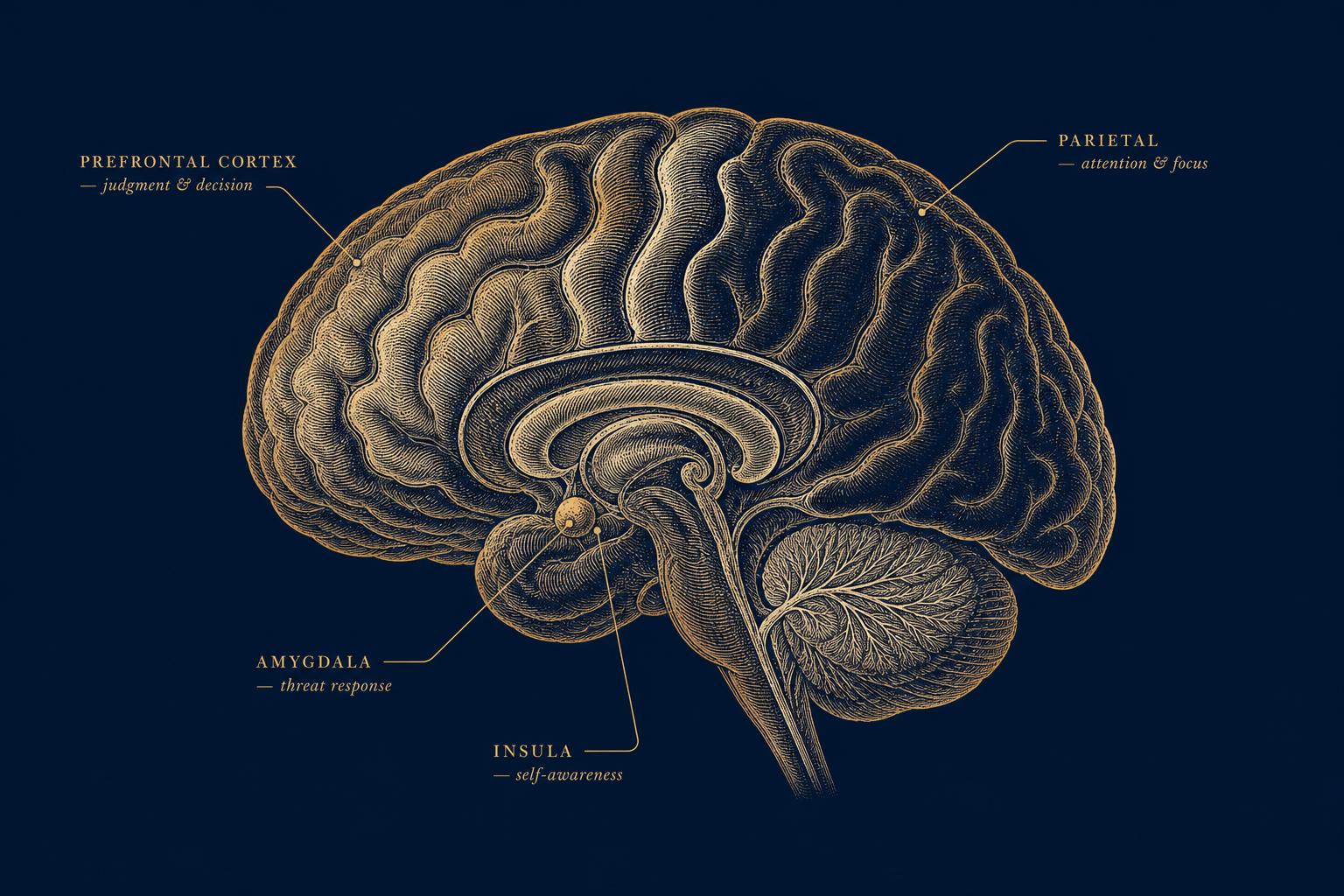
- Threat circuitry fires first. The alarm system does not distinguish a hard question in a boardroom from physical danger. The body commits before the argument is examined.
- The Judge narrates. Its accomplice Saboteurs borrow the urgency, and the story is experienced as fact rather than as one reading of the evidence.
- Sage capability narrows. Deliberate judgment, perspective-taking and empathy are the first functions to degrade — which is precisely what a team needs most at that moment.
- Training is physical. Deliberate exercise develops the human brain and its connections. Repetition strengthens the pathways used under load and lets unused ones weaken — the same principle as loading a bone once it is stabilised.
Level 02 · The team's behavioural contract
Five tiers, drawn as structure: each one carries the weight of everything above it.
01 · Vulnerability-based trust
People can say "I was wrong", "I don't know", "I need help" without cost.
The Judge makes disclosure feel dangerous. Avoider hides the issue, Controller overrides it, Hyper-Achiever performs competence instead of admitting need.
02 · Unfiltered, productive debate
The team argues about ideas in the room, not in the hallway afterwards.
Pleaser keeps the peace, Avoider changes the subject, Controller wins the exchange. The disagreement does not disappear — it relocates.
03 · Clarity and buy-in
Decisions leave the room intact, with an owner and a date.
Stickler and Hyper-Rational keep refining, Restless reopens the option set, Victim quietly withholds. Ambiguity becomes the safest position.
04 · Peer-to-peer accountability
Peers hold the standard without routing every correction through the leader.
Avoider defers the hard conversation, Pleaser protects the relationship, Hyper-Vigilant escalates instead of addressing. The standard drifts to the lowest tolerated level.
05 · Collective focus on results
One scoreboard outranks status, turf and function.
Hyper-Achiever optimises personal record, Controller protects territory, Restless chases the next thing. Local wins accumulate while the enterprise result stalls.
Level 03 · The shared vocabulary
A team cannot practise disclosure until difference stops being read as a verdict.
Style is a starting point, not an explanation and not an excuse. The plate suggests where a given team may find the first tier hardest and what the first repetition looks like — a reading worth examining together, not a classification of people.
Why it belongs in the architecture
A powerful team uses Compass Enterprise Architecture™ to face economic truth and architect the next phase of growth. Mental Fitness and the team contract are how that team stays able to do it under pressure — which is the only condition that ever matters.
Evidence from these instruments is read separately and never averaged into a single score. Where causality is unproven, the reading says so.
03
The pyramid, tier by tier, with the pattern that erodes it
Vulnerability-based trust asks a leader to say "I was wrong", "I don't know", or "I need help" without cost. Avoider changes the subject, Controller overrides, Hyper-Achiever performs competence instead of admitting need. The team concludes it has a trust problem; what it has is a room of people protecting themselves competently.
Unfiltered debate asks for the disagreement in the room rather than in the hallway. Pleaser keeps the peace, Avoider defers, Controller wins the exchange. The conflict is not removed — it relocates to side channels, where it costs more and resolves nothing.
Clarity and buy-in asks that a decision leaves the room intact with an owner and a date. Stickler and Hyper-Rational keep refining, Restless reopens the option set, Victim withholds quietly. Ambiguity becomes the safest position available to everyone.
Peer-to-peer accountability asks colleagues to hold the standard without routing every correction through the leader. Avoider postpones the hard conversation, Pleaser protects the relationship, Hyper-Vigilant escalates rather than addresses. The standard settles at the lowest level the team tolerates.
Collective focus on results asks that one scoreboard outrank status, turf and function. Hyper-Achiever optimizes personal record, Controller protects territory, Restless chases the next thing. Local wins accumulate while the enterprise result stalls — which is the condition most often mistaken for a strategy problem.
Read this way
Two axes, never averaged
Score the tier and name the pattern separately. A weak tier with a clear pattern is trainable behavior. A weak tier with no pattern usually means the operating system — decision rights, priorities, information, cadence — is producing the behavior, and no amount of individual work will fix it.
04
Why DISC belongs at the base of the pyramid
Vulnerability is the hardest thing to ask of a leadership team, because the request sounds like an invitation to be exposed in front of people whose judgment they have not calibrated. DISC solves a narrow, decisive part of that problem: it gives the team a neutral, non-pathologising vocabulary for difference. Pace and outlook, not character.
When a fast, task-first colleague understands that a measured, people-first colleague is not obstructing but sequencing, and the measured colleague understands that directness is not contempt, the interpretation layer changes. Difference stops being read as a verdict. That is the precondition for disclosure: people become vulnerable with colleagues whose responses they can predict.
DISC also makes the first rep concrete for each style. Dominance slows the verdict and names one thing it is unsure of. Influence stays on the specific issue long enough for it to resolve rather than smooth. Steadiness puts the objection on the table inside the meeting. Conscientiousness commits with the evidence available and states the residual risk. Four small, observable acts — and the base tier of the pyramid starts to carry weight.
Used carelessly, DISC becomes a label and Saboteur language becomes an insult. Both are read the same way at Compass: as a description of a response under conditions, never as a permanent statement about a person, and never separate from the system that evokes and rewards that response.
People do not become vulnerable with people they trust. They become vulnerable with people whose responses they can predict.
05
The part that earns board time
None of this is a wellbeing program. The commercial argument is narrower and harder: the decisions that change an enterprise's trajectory are all decisions that trigger pressure responses. Naming the product line that must be de-invested. Stating the real margin on the largest customer. Telling a founder that the capability that built the company is now the constraint. Agreeing that a senior leader is in the wrong seat.
A leadership team that cannot hold those conversations does not get a smaller version of the growth decision. It gets a substitute: an improvement plan that moves the result toward the limit of the current design, while the design itself — and therefore the limit — goes unexamined.
This is why Mental Fitness sits inside FOUNDATION™ in Compass Enterprise Architecture™ rather than beside it. A high-performing team is not the goal; it is the instrument. It is what lets a business face its own economic truth — where value is actually created, what complexity actually costs, which capacity is committed to work that no longer earns it — and then architect the next phase of growth rather than negotiate with the current one.
One further discipline, which Compass treats as non-negotiable: individual awareness is never claimed as an intervention on its own. Every mental fitness or teaming claim ships with a system change alongside it — decision rights, roles, standards, cadence, or the measure pair the team is now held to. Awareness without a system change is a workshop. Awareness with one is architecture.
Use it this week
- Team Health AssessmentThe fifteen-statement read of the five tiers, scored and placed on the pyramid, with the tier the team should work first.
- Mental Fitness Team ReadingEach person enters their own PQ® Score and top three Saboteurs and receives their own reading; the team sheet reports the pattern, never a comparison of named individuals.
- Team Health with DISCThe same five tiers read against the team's behavioral composition, including the styles nobody on the team leads with.
Exhibit
Reading a tier honestly
For each tier, record what the team does, the pattern most visible when it is under load, and the system change that must ship with the behavioral work. Small enough to reproduce on a whiteboard.
| Tier | What it asks | Pattern under load | System change that must ship with it |
|---|---|---|---|
| 01 Trust | Say "I was wrong", "I don't know", "I need help" | Avoider, Controller, Hyper-Achiever | A standing agenda slot where error and risk are reported without consequence |
| 02 Conflict | Argue in the room, not the hallway | Pleaser, Avoider, Controller | Decision rights stated before the debate, so the argument has a purpose |
| 03 Commitment | Leave with an owner and a date | Stickler, Hyper-Rational, Restless | A written decision record read back at the close of every meeting |
| 04 Accountability | Hold the standard peer to peer | Avoider, Pleaser, Hyper-Vigilant | A published standard and a weekly review the leader does not chair alone |
| 05 Results | One scoreboard outranks turf | Hyper-Achiever, Controller, Restless | A shared measure pair across the value stream, not per function |
Two axes are read separately and never averaged: behavior, and the system that evokes it.
Symptoms worth examining before your next growth decision
- The real conversation happens after the meeting, in ones and twos.
- Decisions are relitigated weeks later by people who were in the room.
- Correction only travels through the leader, never between peers.
- Nobody has said out loud what the largest customer or product line actually earns.
- The team can describe an improvement plan in detail and the design assumption behind it not at all.
- One executive's directness, or another's caution, is discussed as a character issue rather than as a pattern under conditions.
A team does not become high-performing by liking each other more. It becomes high-performing when its people can be predictable to each other under pressure, name the economic truth without flinching, and then use that clarity to architect what comes next.
Interactive exercise
Choose it: the team cannot make a growth decision
Pick the first move you would authorize, then read the verdict.
A leadership team has debated the same growth decision for three meetings. Positions are stated carefully, disagreement happens afterward in pairs, and nothing is committed.
The other side of the argument
Send a question or an insight
Nothing here is published. Your note goes directly to Steve Kopecky, who reads every one — reader questions decide what gets written next.
Aligned to FOUNDATION™
Who are we, and what business are we actually trying to build?
Present reality, leadership capability, purpose and organizational health.
Article
Choose the 80 Before You Design the Enterprise: Building a Front-to-Back Strategy on the Vital Few
80/20 is not a cost exercise. It is the first strategic design decision — naming the vital few markets, customers, products and channels the enterprise intends to win, and then connecting that choice front to back.
11 minute read
Article
Clean Sheet Organization Design: Building the Structure the Strategy Requires
A clean sheet design starts from the strategy and the vital few opportunities, not from the current org chart. This is the process, the ownership and the SIPOC that governs it.
9 minute read
Assessment
FOUNDATION™ Diagnostic
A structured read on leadership capability, clarity of purpose, trust and organizational health.
Maturity read on screen, a print sheet, and an emailed copy.
Assessment
Lifecycle Stage Diagnostic
Fifteen statements that locate the business on the curve — Honeymoon through Reinvention — and name the binding constraint.
Stage placement, constraint, and the first move for that stage.
Instrument
30 / 60 / 90 Day Action Plan
Turns the lifecycle result into sequenced work: the stage supplies the architectural move, the lowest-scoring domain supplies what removes the constraint. Owners, dates and check-off included.
A checkable plan on screen and a board-quality PDF of the three horizons.
Instrument
Lifecycle Before & After Sheet
Holds the diagnostic result as the before, the stage and domain targets being architected as the after, the operating measures the change is judged against, and the reinvention actions carried from the ninety-day plan.
A one-page board-quality before-and-after PDF, plus an emailed copy.
Podcast
Kristina George — How an office manager became an owner leading a team of eighteen.
Kristina George describes the move from operator to owner and the decisions that made it hold. The conversation examines anchoring the agency on explicit values, investing in employee engagement, and simplifying the operating model so growth did not dilute the culture.
Podcast
Mike Domitrz — How a mission born from tragedy became a leadership standard.
Mike Domitrz shares the origin of The Center for Respect after his sister's assault in college, and how the work grew into a program trained across universities, high schools, the military, and businesses. The conversation examines how respect becomes an observable leadership behavior rather than a value on a wall.
Guide
Read the Curve Before You Build the Next One
The second curve is a timing decision before it is a strategy decision. Most companies read the curve years late, at the point where the options are cheapest to see and most expensive to take.
7 minute read
Engagement
Compass Executive Forums
A confidential peer table of owners and executives working the same architecture, month after month.
Monthly, by invitation
Engagement
The Compass Enterprise Architecture™
The core architecture Compass designs and installs with a leadership team.
The authoritative source