One enterprise architecture. FOUNDATION™ · SIMPLIFY™ · LEAD™ · GROW™ · ARC™.
The Compass Enterprise Architecture™
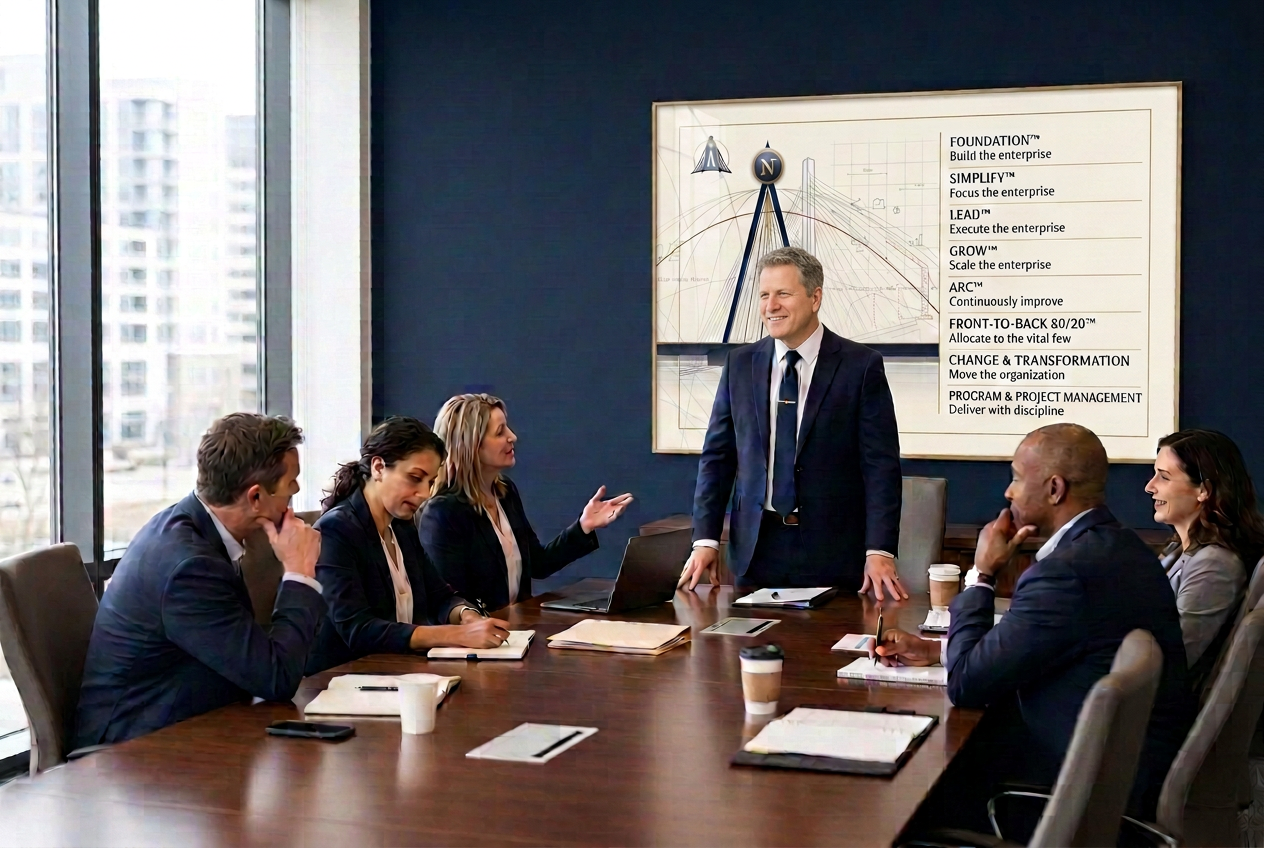
What a client gains is a way to move from complexity to sustainable performance — an operating architecture their own leaders can run. FOUNDATION™, SIMPLIFY™, LEAD™ and GROW™ build the enterprise; ARC™ renews it; Front-to-Back 80/20™, Change & Transformation™ and Program & Project Management™ execute it. Each answers one question the next cannot answer without it.
This page answers one question: How does Compass work?
One architecture
Eight areas. One enterprise operating architecture.
FOUNDATION™, SIMPLIFY™, LEAD™ and GROW™ build, focus, execute and scale the enterprise. ARC™ renews them. The execution disciplines carry the architecture into the work people do every day.
Enter through a discipline
FOUNDATION™ · SIMPLIFY™ · LEAD™ · GROW™ — renewed by ARC™.
01 · The core architecture
FOUNDATION™
Build the Enterprise
SIMPLIFY™
Focus the Enterprise
LEAD™
Execute the Enterprise
GROW™
Scale the Enterprise
02 · The renewal engine
03 · Enterprise execution disciplines
The architecture, indexed
Simple on top. Deep underneath. Open only what you want to read.
The present reality
Most organizations evolve. Few are intentionally architected.
As complexity grows, strategy fragments, decisions slow, accountability blurs, and execution weakens. The issue is rarely effort. It is the system beneath the effort.
- Growth is outrunning the organization.
- Decisions are moving upward instead of outward.
- Complexity is consuming margin and capacity.
- The leadership team is capable — but inconsistent together.
- Strategy still depends on individual heroics.
What changes
When the architecture changes, the results change.
- Complexity reduced
- Portfolios rationalized against where value is actually created — margin recovered without losing revenue.
- Executive teams aligned
- One operating cadence with owners, dates and evidence, so decisions close instead of recirculating.
- Successors made ready
- Developed against the requirements of the future role, on a real timeline rather than an assumed one.
- Capability that stays
- The disciplines are installed, then run by your leaders — not dependent on us.
Client engagements are confidential. Outcomes are described as engagement patterns, without identifying details.
We partner with organizations to replace complexity with a practical operating system that aligns leadership, strategy, operations and people around what creates the most value.
- FOUNDATIONBuild“Who are we, and what business are we actually trying to build?”
- SIMPLIFYFocus“What deserves our attention?”
- LEADExecute“How do we align people around the work that matters most?”
- GROWScale“Can our operating system handle tomorrow's success?”
- ARCRenew“What changed, what did we learn, and what must we refocus?”
ARC™ returns the enterprise to FOUNDATION. This is not a linear program — it is a continuous operating system.
The five high-level disciplines
Foundation establishes the conditions for change. Leadership capability, values, vision, purpose, trust and organizational health are settled here — along with an honest read of where the business sits in its lifecycle.
Front-to-Back 80/20 becomes the operating philosophy. The organization identifies the vital few customers, products, services and processes that create disproportionate value — and names the complexity to remove.
Only once the organization knows where it is, what matters and what demand exists can leadership become effective. Lead builds the behaviors and daily disciplines that make execution consistent rather than heroic.
Growth is not simply more sales. It is a business that scales without proportionally increasing complexity — designed around customer demand and operational flow rather than around organizational history.
ARC — Assess, Refine and Commit — is the organization's learning engine. It keeps the operating model dynamic, so the system adapts before success turns into stagnation.
ARC™ returns the enterprise to FOUNDATION™. This is a continuous operating system, not a linear program.
Most improvement work fails not because the tools are wrong, but because they are applied out of order. Leadership development without focus produces generic skills. Focus without an honest current state addresses symptoms. Growth without an aligned system adds complexity faster than capability.
Every great organization is built twice: first in architecture, then in execution.
What breaks when a stage is skipped
Without an honest current state, every improvement risks addressing symptoms rather than causes. Are we in the Founder's Trap? Stuck in Success? In Denial? Trying to grow without systems?
Without simplification, everything competes equally for limited time, people and capital. With it, the business allocates deliberately to the highest-value work.
Leadership development detached from the operating model produces generic skills. Here it produces leaders who can execute this system.
Growth pursued as an isolated objective adds complexity faster than capability. Here it is the outcome of the three stages before it.
Without a learning engine, an organization defends yesterday's success. ARC is the discipline that prevents the Success Trap and the Denial Trap.
One architecture
Read top to bottom. First the core architecture — FOUNDATION™, SIMPLIFY™, LEAD™ and GROW™ — that builds, focuses, executes and scales the enterprise. Then ARC™, the renewal engine that keeps it honest. Then the execution disciplines that carry the architecture into the work people do every day. In that order, the architecture explains why performance is what it is.
01 · The core architecture · 02 · The renewal engine
Foundation establishes the conditions for change. Leadership capability, values, vision, purpose, trust and organizational health are settled here — along with an honest read of where the business sits in its lifecycle.
Explore FOUNDATIONWhat it decides
- Leadership capability
- Values, vision and purpose
- Trust and organizational health
- Current lifecycle assessment
Front-to-Back 80/20 becomes the operating philosophy. The organization identifies the vital few customers, products, services and processes that create disproportionate value — and names the complexity to remove.
Explore SIMPLIFYWhat it decides
- Which customers matter most
- Which products and services matter
- Which processes create value
- Which complexity should be removed
- What the market rate of demand actually is
Only once the organization knows where it is, what matters and what demand exists can leadership become effective. Lead builds the behaviors and daily disciplines that make execution consistent rather than heroic.
Explore LEADWhat it decides
- Accountability and decision rights
- Coaching and communication
- Conflict and the leadership pipeline
- Visual management
- Daily management
Growth is not simply more sales. It is a business that scales without proportionally increasing complexity — designed around customer demand and operational flow rather than around organizational history.
Explore GROWWhat it decides
- Scalable processes and manufacturing flow
- Market rate of demand
- Product families and capacity planning
- Customer experience and innovation
- Strategic planning
ARC — Assess, Refine and Commit — is the organization's learning engine. It keeps the operating model dynamic, so the system adapts before success turns into stagnation.
Explore ARCWhat it decides
- Assess what actually changed
- Refine the 80/20 as demand shifts
- Commit to the next set of countermeasures
- Name today's bottleneck
- Test for lifecycle drift
One level deeper
The method detail sits beneath the architecture, not on top of it.
These run horizontally beneath the core architecture and its renewal engine. They are how a decision made in the boardroom becomes an activity on the floor — and how it stays there after the attention moves on.
01
Front-to-Back 80/20™
Strategy → Segmentation → Prioritization → Resource Allocation → Operating Flow → Daily Activity Management → Results.
A cross-system discipline, not a SIMPLIFY sub-methodology. It begins in SIMPLIFY and extends through LEAD and GROW, depending on FOUNDATION to hold.
Explore 80/2002
Change & Transformation™
Intent → adoption → sustainability.
The horizontal value stream that moves any change — ERP, acquisition, restructuring, succession — from intent to sustained performance.
Explore Change & Transform03
Program & Project Management™
Strategy → coordinated execution → value realization.
Enterprise, portfolio, program and project management as one governed architecture, not a collection of delivery tools.
Explore PPM
FOUNDATION™ · SIMPLIFY™ · LEAD™ · GROW™ — renewed by ARC™.
- FOUNDATION™ · BuildEnterprise Operating ArchitectureHow decisions, work, measures and accountability are designed to fit together.Read it
- SIMPLIFY™ · FocusOrganizational SimplificationFront-to-Back 80/20 — the vital few kept, the complexity removed.Read it
- LEAD™ · ExecuteLeadership Operating SystemsDecision rights, cadence and daily management that make execution repeatable.Read it
- LEAD™ · ExecuteTransformation ReadinessWhether the organization can absorb the change it has committed to.Read it
- GROW™ · ScaleBusiness ScalabilityCapacity, capability and structure built to carry the next stage of growth.Read it
- SIMPLIFY™ · FocusERP & Digital Transformation ReadinessThe management system settled before the system of record is configured.Read it
- GROW™ · ScaleAI ReadinessClean processes, owned data and clear decisions — the conditions AI requires.Read it
- ARC™ · RenewExit & Enterprise Value ReadinessSuccession architecture and the transferable value a buyer or successor inherits.Read it
Exhibit 02bEight capabilities, each one a discipline of the Compass Enterprise Architecture™ applied to a specific enterprise decision. Prepare the organization. Focus the change. Mobilize people. Build capability. Sustain the value.
Why
We need to change because the current way will not produce the future we need.
What
We are changing the system — not simply asking people to work harder.
How
We will prepare, focus, execute, build capability, and sustain the gains.
- 01
READY
FOUNDATIONBefore anything is mobilized, the enterprise has to be honest about whether it is ready to change at all.
- 02
FOCUS
SIMPLIFYA transformation that changes everything changes nothing. Simplify names what must change, and what must stop.
- 03
MOBILIZE
LEADThis is where change becomes visible: leaders link strategy to purpose, people engage, and adoption is managed rather than assumed.
- 04
PERFORM
GROWThe new model stops being a project and becomes how the enterprise operates — and scales.
- 05
SUSTAIN
ARCAssess, Refine and Commit converts project change into operating discipline — and tests whether adoption is actually holding.
Transformation management
- Case for change
- Impact
- Adoption
- Performance
- Reinforcement
The processChange is the event. Transformation is what remains after the event, because the system changed with it.Five gates. Each one has a question it must answer, a decision that must be made, evidence that proves it happened, and an owner. Nothing advances on optimism.
Do we have the case, the sponsorship and the capacity to change at all?
What must be true to pass
Named executive sponsor, quantified cost of the status quo, and confirmed capacity — dissatisfaction and vision must exceed the cost of change before funding is released.
Owner
CEO and executive sponsor
Evidence it happened
- Written case for change with the number attached
- Signed sponsorship and decision rights
- Change-load map of what is already in flight
- Readiness baseline and known resistance
Skip this gate andThe program launches into an organization already at capacity and stalls at the first competing priority.
What must change, what must stop, and in what order?
What must be true to pass
A sequenced scope with an explicit stop list, named impacted populations, and one measurable outcome per workstream.
Owner
Executive team and process owners
Evidence it happened
- Scope and stop list — what will not be done
- Stakeholder-impact map by population
- Sequence with dependencies and capacity release
- Baseline measures for every promised outcome
Skip this gate andScope expands to everything, nothing finishes, and the organization concludes that transformation means extra work.
Do the people who must work differently understand, accept and know how?
What must be true to pass
Adoption is managed, not assumed: leaders can state the change in their own words, capability is built before go-live, and resistance is answered rather than escalated.
Owner
Line leadership, supported by Compass
Evidence it happened
- Cascade with one consistent story per audience
- Capability and training delivered before cutover
- Operating rhythm running — weekly, monthly, quarterly
- Adoption measured by behavior, not attendance
Skip this gate andThe design is technically correct and behaviorally ignored — the old way survives inside the new system.
Is the new model producing the result it was funded to produce?
What must be true to pass
Benefits tracked against the original baseline, ownership transferred to the line, and the project scaffolding removed.
Owner
Functional owners and the management team
Evidence it happened
- Outcome measures against baseline, not activity reports
- Ownership formally handed to the line
- Successors and internal capability in place
- Standard work documented and in use
Skip this gate andValue is declared at go-live, never verified, and the improvement quietly reverses within two quarters.
Is adoption holding, and what does the next cycle need to correct?
What must be true to pass
ARC — Assess what held, Refine what did not, Commit to the improved standard on a named cadence with an owner.
Owner
Management team, on cadence
Evidence it happened
- After-action review against the original charter
- Countermeasures with owners and dates
- Revised standard committed and in the operating rhythm
- Lessons carried into the next cycle
Skip this gate andNothing accumulates: the same problem is rediscovered and re-consulted eighteen months later.
The common demand language, the operating wall, enterprise systems as enablers, how an engagement is structured, and the record that closes a stage — all held on one depth page so this page can stay an architecture.
The same five gates translate by transformation type, by audience, and into plain adoption steps. That detail sits one level deeper so this page stays an architecture.
How the gates translateThe operating system, done right, becomes the organization’s secret sauce.
Competitors can copy a product, match a price, hire the same people and buy the same technology. What they cannot copy is the way an organization decides, aligns, executes and renews itself week after week. That is architecture — and it is the one advantage that compounds instead of eroding.
Not purchasable
No vendor sells it and no benchmark hands it over. It is designed for one enterprise, on that enterprise’s own demand signal.
Not observable
A visitor sees the wall and the meeting. They do not see the decision rights, cadence and standards that make either one work.
Not static
ARC™ renews it every cycle, so the advantage widens while imitators are still copying last year’s version.
Architecture determines performance. Repeated, it becomes reputation.
Every great organization is architected
The Blueprint of Organizational Performance
Every bridge begins long before the first beam is installed. Organizations are no different. Lasting performance is designed before it is executed.
Every organization is built on an operating system — whether intentionally designed or allowed to evolve by accident. Compass uses the bridge to illustrate the architecture required to turn vision into sustained performance. Every structural element represents a discipline that must work together for the organization to carry greater weight, adapt to change, and endure over time.
Most organizations spend years fixing symptoms. Very few redesign the system creating them.
Four load-bearing elements, one architecture
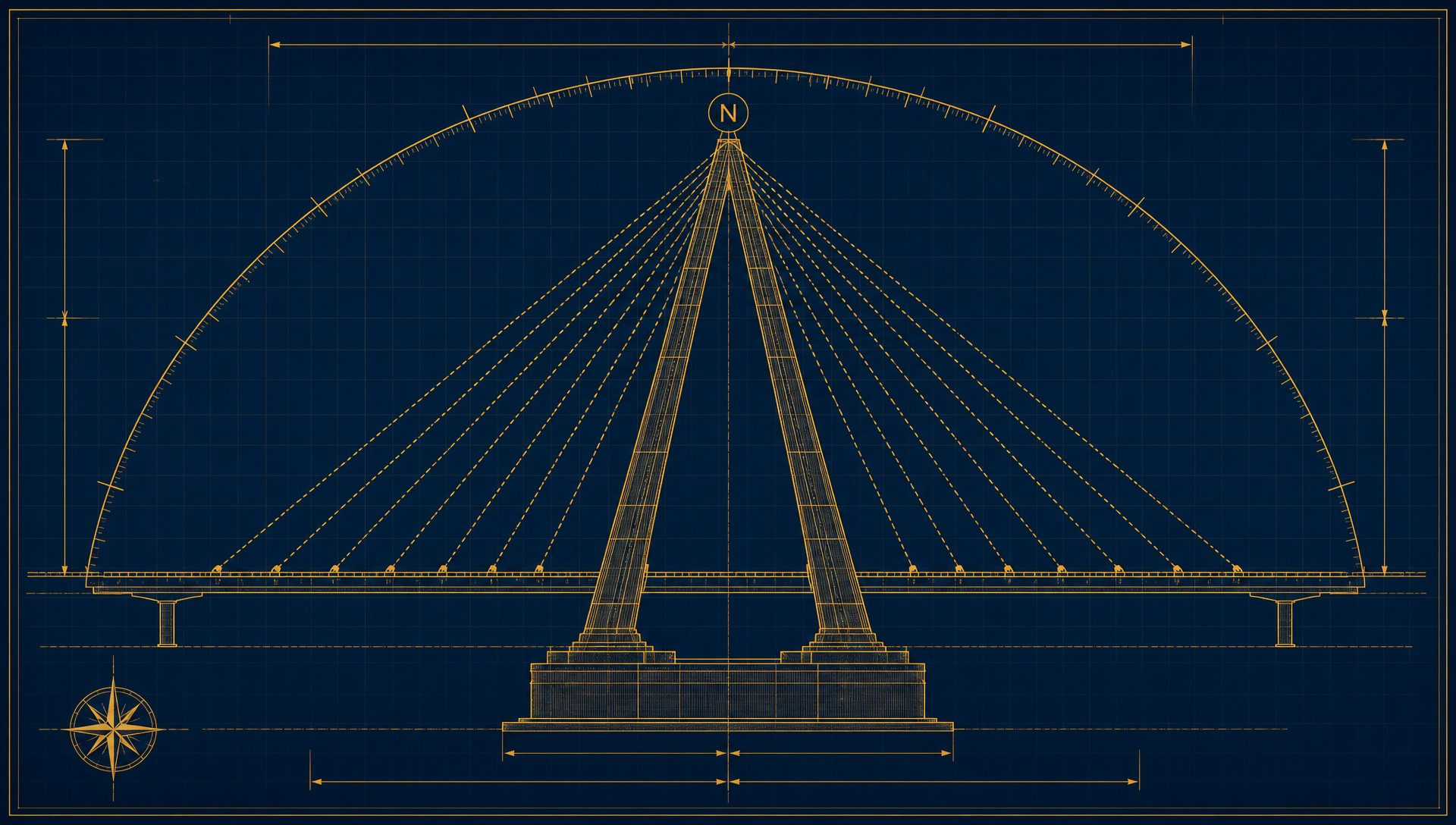
Every organization carries weight across these four elements. The Deck — where Meeting Guidelines and Cadence live — is what turns the architecture into a system people actually travel.
No blueprint element highlighted. Select an entry to highlight it.
Everything begins below the surface. Values, governance, decision rights, trust, accountability and leadership discipline determine how much weight an organization can carry. Weak foundations eventually fail under growth.
Organizations drift when purpose is unclear. A clearly defined destination aligns decisions, investments, priorities and behavior throughout the enterprise. Every successful organization knows where North is.
The bridge exists because every component supports the others. Simplify removes unnecessary complexity. Lead aligns people and decisions. Grow expands capability without sacrificing performance. Together they create an operating system — not isolated initiatives.
The strongest framework carries nothing without a deck. The deck is the operating cadence — meeting rigor, standing agendas, recorded action items, scheduled reviews, and the few metrics that confirm the enterprise is actually crossing the bridge. Architecture without cadence is a blueprint no one travels.
The Deck, Up Close
Five load-bearing elements must be built in — not improvised.
Meeting Rigor
Every standing meeting has one owner, one standing agenda, and one required output. A meeting that produces no decision for two cycles is cancelled or redesigned.
Agendas
Materials circulate before the room opens. A meeting spent reading is a meeting wasted — preparation happens before, not during.
Action Items
Decisions are recorded with an owner and a date, or they were not decisions. The prior action log is the first agenda item of the next meeting.
Reviews
Governance, financial, and operating reviews run at protected cadence. The calendar moves for customers, not for convenience.
Metrics
The few measures that tell you whether the enterprise is actually crossing the bridge — reviewed on rhythm, not on demand. They are chosen to track movement toward True North, not activity; when the measures move together in the right direction, the crossing is real, not merely busy.
Meeting Ground Rules
A meeting is the smallest unit of the operating system. Run it well and the whole deck holds. The rules are simple — and non-negotiable.
- Start and end on time.
- Come prepared.
- Be accountable for your agreed actions and responsibilities.
- No intimidation.
- No bad answers.
- Everyone participates.
- One conversation at a time.
- Use a parking lot — off-topic items are captured, not lost.
- Decisions are documented before anyone leaves the room.
The fifth load-bearing sub-element
Meeting Guidelines and Cadence
The first four elements of the Deck — meeting rigor, agendas, action items, and reviews — describe what runs. Meeting Guidelines and Cadence is the fifth: the discipline that keeps every meeting honest, on time, and on the system. Start and end on time, one conversation at a time, decisions documented before anyone leaves the room. It is the sub-element that holds the other four together — and the one most organizations leave to chance.
The strongest framework carries nothing without a deck.
Organizations rarely outperform their architecture.
Why the system matters
Time = Life
The most finite resource inside any enterprise is not capital. It is the hours of the people who have chosen to spend part of their lives there.
- Every hour someone spends inside your organization is an hour of their life they will never get back.
- Leadership is not measured by how hard people work. It is measured by whether their work mattered.
- Reinvention is how leaders honor the lives entrusted to them.
- Organizations don’t reach the second curve by working harder. They reach it by redesigning the architecture that produces results.
Go one layer deeper
Begin with FOUNDATION™ — how we understand present reality
The first discipline: values, present reality and the capability everything else depends upon.
- Diagnostics & assessments
See the system through evidence before deciding anything.
- How Compass thinks
The writing beneath the architecture.
Complexity falls
The vital few are named and funded. The rest stops competing for attention.
Alignment holds
Leadership, strategy, operations and people work from one demand signal and one wall.
Performance compounds
ARC™ converts each cycle into the next set of countermeasures rather than a defended past.
The Compass Difference is what makes the architecture work as one integrated architecture — from mental fitness to cross-functional alignment to the second curve.
Read the architecture in full: the ten elements of an enterprise operating architecture.
There are three honest next steps: score the system, read the architecture, or have one focused conversation. Choose the one that matches how you prefer to decide.
Compass Enterprise Readiness Assessment™
Request your Enterprise Readiness Report
A written read of your enterprise against the ten architected elements of the operating system — where the design carries the next stage of growth and where it does not.
- Element-by-element readiness across the whole architecture
- The two gates that must clear before anything else pays back
- One executive conversation to walk the findings
Prepared and released by a Compass administrator — never auto-generated. Or take the assessment yourself first: the readiness assessment.
The next step
Ready to see the architecture differently?
A focused introductory conversation. We will clarify what is happening, why it matters, and whether a deeper dialogue makes sense.
Not sure where to start?
Three questions, and we point you to the right instrument.
Under a minute. From this page, most leaders begin with The organization.