Program & Project Management
The Next Phase Is Delivered Across Boundaries — Which Is Why Program Management Becomes a Capability, Not a Role
Every organization reaches a point where the next result cannot be produced inside a single function. At that point the constraint is no longer effort, talent or intent — it is the absence of a disciplined way to carry work across boundaries that were, until now, a source of strength.
Written by Steve Kopecky · 13 minute read
Founder & Principal, Compass Performance, Inc.
01
Functional excellence is what gets an organization stuck
Most organizations grow by becoming very good at something inside a boundary. Operations learns to hold the plant. Sales learns to hold the customer. Engineering learns to hold the product. Finance learns to hold the number. Each function develops its own priorities, cadence, language and informal authority, and for a long period that specialization is exactly what produces the result.
The next phase — a new market, a platform product, an acquisition integrated properly, an ERP replaced, a founder's operating role transferred, a service model rebuilt around the customer — is never contained inside one of those boundaries. It runs across all of them, in sequence, with hand-offs that nobody owns and dependencies that nobody scheduled.
This is why capable organizations stall on their most important work while their routine work continues to perform. Routine work lives inside the boundary, where the operating system is strong. Transformational work lives between boundaries, where there is often no operating system at all.
The boundaries that made the organization strong are the exact boundaries its next phase has to cross.
02
What actually fails at the boundary
The failure pattern is consistent and it is structural, not motivational. Work is committed without a named accountable owner who spans the functions involved. Dependencies are assumed rather than scheduled, so each function plans as though it were the only claim on a shared resource. Decisions surface late because there is no forum with the authority to make them. Scope moves quietly, because nobody holds a baseline to move it against.
Then the reporting problem appears. Each function reports its own view honestly, and the aggregate is still wrong, because nobody is reading the same record. The sponsor hears activity — meetings held, workshops run, documents drafted — instead of the two facts that matter: is the promised date still achievable, and what would it cost to hold it.
None of that is solved by asking the same people to try harder or to communicate better. It is solved by installing a capability that makes cross-boundary work visible, sequenced, owned and reviewable.
Diagnostic
Six questions that expose the gap
Who is accountable for the whole outcome, not a slice of it? What is the current baseline, and when was it last changed deliberately? Which activities set the finish date? What does pulling the date in cost, priced? Which decisions are waiting, and who owns each one? What evidence is required to pass the next gate? If any answer takes more than a day to assemble, the capability is missing — not the information.
03
Program management is a capability, not a coordinator
The common first move is to appoint a coordinator: a capable person asked to chase status across functions with no authority, no baseline and no method. That role burns out reliably, because it is being asked to substitute personal effort for an absent system.
A capability is different. It has a defined unit of work — the project, with a charter, sponsor, scope, baseline and success tests. It has a level above that — the program, which holds projects that share an outcome, and resolves the trade-offs between them. It has a portfolio view, which decides what is funded and what waits, because capacity is finite. And it has a method: how work is planned, scheduled, risk-assessed, governed, changed and closed.
Read against best practice — PMI's process framework, stage-gate governance from product development, earned-value discipline from capital projects, agile cadence where scope is genuinely emergent — the common denominator is not the notation. It is that the work has a record, the record has an owner, and decisions are made against evidence held in that record.
Compass places this discipline where it belongs: Program & Project Management is one of the enterprise execution disciplines, the mechanism by which architected design actually reaches live operation. Without it, architecture stays a document.
A coordinator chases status. A capability holds a record that makes status unnecessary to chase.
04
The seven things a real capability installs
First, a chartered unit of work. Every project has a written sponsor, a business question, a scope boundary, a stated benefit and success tests agreed before work starts. Anything without a charter is effort, not a project.
Second, a schedule with logic. Activities carry durations, predecessors and constraints, which produces early and late dates, float and a critical path. This is the difference between a plan and a list of dates: a plan tells you which slippage matters.
Third, single-point accountability per activity. RACI applied at activity level, one accountable name each. Two accountable names is the boundary failure written down.
Fourth, priced options instead of assertions. When a date is under pressure, the sponsor should receive crashing priced per day bought, fast-tracking priced in rework exposure, and descope framed as a capability decision — not a promise to try.
Fifth, risk assessed on the process being designed. An FMEA on the new way of working — severity, occurrence, detection, and a named control for anything scoring high — catches the failure before the customer does.
Sixth, gates that pass on evidence. Each gate has binary pass criteria, the evidence required, the owner who decides, and the failure mode it exists to catch. Optimism is not evidence.
Seventh, adoption planned alongside delivery. Training, communication and role playbooks are in the plan, because a framework nobody was trained on is not installed. Closure includes transfer of ownership to a named internal person and a scheduled ARC review — assess, refine, commit — so the capability improves rather than decays.
Use it this week
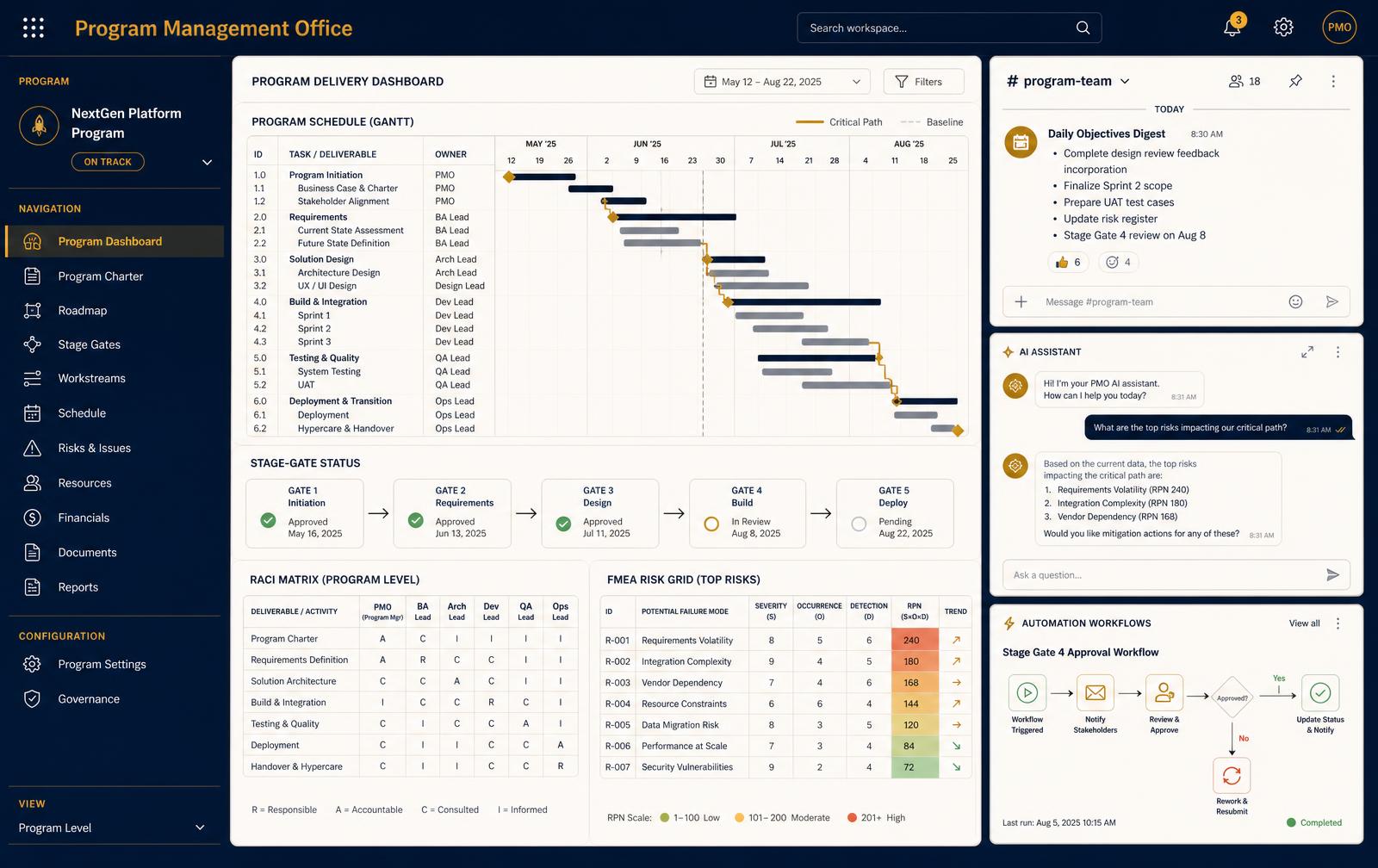
- Program & Project Delivery ArchitectureThe delivery architecture behind the desk: activity network, critical path and float, priced compression scenarios, activity-level RACI, stage gates, the FMEA and the executive reading. The editable delivery record itself opens from the Tools desk after sign-in.
- FMEA sheetScore the failure modes of the process being designed, and name the control that answers each one, before it reaches a customer.
05
The momentum problem: capability has to be usable on Monday
Most program management initiatives die of weight. A methodology is written, templates are issued, a governance calendar is published — and the working leaders quietly keep running the work out of their inboxes, because the official system costs more to feed than it returns.
The counter is to make the record the easiest place to work, and to let the surrounding tools read from it rather than duplicate it. That is a design decision about where truth lives: one delivery record holds the plan, the dates, the owners, the risks and the gate evidence. Everything else announces, assists or automates against it.
In practice that means the weekly agenda is generated from the live plan rather than typed. The daily objectives each owner receives come from the same schedule that produced the critical path. The status the sponsor reads is the record printed, not a slide assembled by hand. When those three things are true, the system is cheaper to use than to avoid — and that is what produces momentum.
A method survives only when using it is cheaper than working around it.
06
How the working stack fits together
The Compass program management office is deliberately assembled from tools organizations already tolerate, with one rule: the delivery record is the source of truth, and no tool is allowed to become a second one.
Slack is the announcement layer. Channels carry the daily objectives digest, the late-activity read and the posted status sheet, each with a link back to the record. Slash commands answer read-only questions — status, what is late, what is mine — so people stop asking each other for status. Slack never holds the plan.
Lovable is where the record and its instruments live: the delivery desk, the diagnostics, the printed sheets and the client-facing surfaces, built and changed at the speed the engagement actually moves. Because the record is server-held, a program manager on another device or a sponsor in another city opens the same plan rather than a forwarded copy.
ChatGPT is the interpretation layer for the program manager. Given the record — the schedule, the risks, the minutes — it drafts the executive reading, stress-tests the logic, proposes failure modes for the FMEA and rehearses the sponsor conversation. It proposes; a named human accepts. Proposals are recorded as proposals, never written silently into the plan.
Lindy is the automation layer for the routine motion around the record: the digest that goes out at the right hour, the reminder before a gate, the escalation when an activity passes its late finish, the filing of a decision into the client's Dropbox folder where artifacts are the record of truth. Automation moves the work; it never invents the facts.
Read together, the pattern is simple and it is the reason it holds: one record, one owner per activity, announcements outward, interpretation and automation reading in — with every write by a human who is accountable for it.
Boundary rule
One record, four roles around it
Record: the delivery plan, gates, RACI, FMEA and evidence. Announce: Slack digests, status posts, read-only commands. Build: the desk, sheets and client surfaces. Interpret: AI drafts the reading and proposes; a human accepts. Automate: scheduled digests, reminders, escalations and filing. If a tool starts holding facts the record does not have, the architecture has drifted.
07
How Compass starts an organization on this
Compass does not begin by issuing a methodology. It begins by reading how cross-boundary work is actually being delivered today: what is chartered, what is scheduled, where hand-offs fail, which decisions are stuck, and what the current way of working is costing in time and rework. That read is evidence, gathered forward, not an opinion about maturity.
From there the work is deliberately small and load-bearing. One or two live programs are chartered properly and run on the delivery desk — real work, not a pilot exercise — so the method is proven on outcomes the leadership team already cares about. The governance cadence is installed around them: a weekly working review generated from the plan, a monthly sponsor reading, and gates with written pass criteria.
In parallel, the framework and the role playbooks are documented: how the organization runs programs and projects, and how each role — sponsor, program manager, project lead, workstream owner, functional contributor, PMO analyst — operates inside that framework. A framework says how the organization works. A playbook says how a role works within it. Both are written, both are trained, both are owned by named internal people.
Then the capability is transferred. Internal program managers run the next wave with Compass alongside rather than in front, the FMEA and gate discipline are applied by the client's own people, and the ARC loop is scheduled so the framework is refined from evidence instead of being rewritten every two years.
The test at the end is not whether Compass delivered the program. It is whether the organization can now deliver the next one without us. Compass leaves business architects, not dependency.
Use it this week
- Begin a conversationBring one stalled cross-boundary program. That single case usually shows the whole capability gap — and it is where installation starts.
Exhibit
Where the capability is missing — and what installs it
Read the left column against the last twelve months of cross-boundary work. Each condition has a specific installation, not a general improvement.
| Condition you can observe | What it actually is | What installs the fix |
|---|---|---|
| Status differs depending on who is asked | No single delivery record | One chartered record with a baseline and an owner |
| Dates slip without anyone being surprised | No schedule logic, so nothing tells you which slip matters | Activity network with durations, predecessors, float and a critical path |
| Two functions both believe the other is accountable | Accountability held at project level, not activity level | Activity-level RACI, one accountable name per line |
| Date pressure answered with a promise | No priced options | Crash, fast-track and descope scenarios priced against the cost of delay |
| The new process fails in front of a customer | Risk assessed on project admin, not on the process being designed | FMEA with a named control for every high score |
| Gates pass because the meeting was scheduled | Governance without evidence | Binary pass criteria, required evidence, named decider per gate |
| The framework decays six months after go-live | No owner and no revision trigger | Named internal owner, role playbooks, scheduled ARC review |
Conditions suggest where to look; they do not set priority by themselves. Priority comes from the economic consequence of the work being blocked.
Symptoms worth checking your own organization against
- The most important initiative of the year has no single accountable owner spanning the functions involved.
- Nobody can say, within a day, which activities currently set the finish date.
- Cross-boundary work is reviewed by asking each function for an update rather than by reading one record.
- Scope has moved several times and no baseline change was recorded.
- Decisions wait weeks because the forum that could make them does not exist or lacks authority.
- Risk conversations are about the project's administration, not about how the new process will fail in operation.
- Training and communication are planned after go-live rather than inside the plan.
- Nobody internal is named as the owner of the way projects are run.
Program and project management is not administrative overhead attached to important work. It is the capability that allows an organization to produce a result no single function can produce alone — which is precisely the definition of its next phase.
Interactive exercise
A role, or a capability?
Click the response that builds capability rather than dependency.
Three programs are crossing functions at once and each is slipping at a different hand-off.
The other side of the argument
Send a question or an insight
Nothing here is published. Your note goes directly to Steve Kopecky, who reads every one — reader questions decide what gets written next.
Aligned to FOUNDATION™
Who are we, and what business are we actually trying to build?
Present reality, leadership capability, purpose and organizational health.
Article
Choose the 80 Before You Design the Enterprise: Building a Front-to-Back Strategy on the Vital Few
80/20 is not a cost exercise. It is the first strategic design decision — naming the vital few markets, customers, products and channels the enterprise intends to win, and then connecting that choice front to back.
11 minute read
Article
Clean Sheet Organization Design: Building the Structure the Strategy Requires
A clean sheet design starts from the strategy and the vital few opportunities, not from the current org chart. This is the process, the ownership and the SIPOC that governs it.
9 minute read
Assessment
FOUNDATION™ Diagnostic
A structured read on leadership capability, clarity of purpose, trust and organizational health.
Maturity read on screen, a print sheet, and an emailed copy.
Assessment
Lifecycle Stage Diagnostic
Fifteen statements that locate the business on the curve — Honeymoon through Reinvention — and name the binding constraint.
Stage placement, constraint, and the first move for that stage.
Instrument
30 / 60 / 90 Day Action Plan
Turns the lifecycle result into sequenced work: the stage supplies the architectural move, the lowest-scoring domain supplies what removes the constraint. Owners, dates and check-off included.
A checkable plan on screen and a board-quality PDF of the three horizons.
Instrument
Lifecycle Before & After Sheet
Holds the diagnostic result as the before, the stage and domain targets being architected as the after, the operating measures the change is judged against, and the reinvention actions carried from the ninety-day plan.
A one-page board-quality before-and-after PDF, plus an emailed copy.
Podcast
Kristina George — How an office manager became an owner leading a team of eighteen.
Kristina George describes the move from operator to owner and the decisions that made it hold. The conversation examines anchoring the agency on explicit values, investing in employee engagement, and simplifying the operating model so growth did not dilute the culture.
Podcast
Mike Domitrz — How a mission born from tragedy became a leadership standard.
Mike Domitrz shares the origin of The Center for Respect after his sister's assault in college, and how the work grew into a program trained across universities, high schools, the military, and businesses. The conversation examines how respect becomes an observable leadership behavior rather than a value on a wall.
Guide
Read the Curve Before You Build the Next One
The second curve is a timing decision before it is a strategy decision. Most companies read the curve years late, at the point where the options are cheapest to see and most expensive to take.
7 minute read
Engagement
Compass Executive Forums
A confidential peer table of owners and executives working the same architecture, month after month.
Monthly, by invitation
Engagement
The Compass Enterprise Architecture™
The core architecture Compass designs and installs with a leadership team.
The authoritative source
Related insights
Where this reading continues
- Organizational Architecture
The Architecture That Created Today's Success Rarely Produces Tomorrow's Results
The boundary problem is a design problem: the structure that produced today's results is the constraint on the next phase.
6 minute read → - Organization Design
Clean Sheet Organization Design: Building the Structure the Strategy Requires
When the next phase requires a different structure, program management is how the new design is actually installed.
9 minute read →