Owner readiness
Goals, timing, identity, emotional readiness and life after ownership.
BUILD ENTERPRISE VALUE.REDUCE OWNER DEPENDENCY.CREATE OPTIONS.
Exit planning is not a sale event. It is the deliberate architecture of a more valuable, transferable enterprise — one that protects the secret sauce, strengthens sustainable enterprise architecture and prepares the owner, leadership team and organization for whatever comes next.
Readiness
Owner
Readiness
Enterprise
Readiness
Financial
Readiness
Leadership & succession
Readiness
Market
Readiness
Transition
Six readiness dimensions, read together. The score establishes the evidence before any plan is drawn.
You do not have to be ready to sell to benefit from exit planning.
Owner · Enterprise · Financial · Leadership & succession · Market · Transition
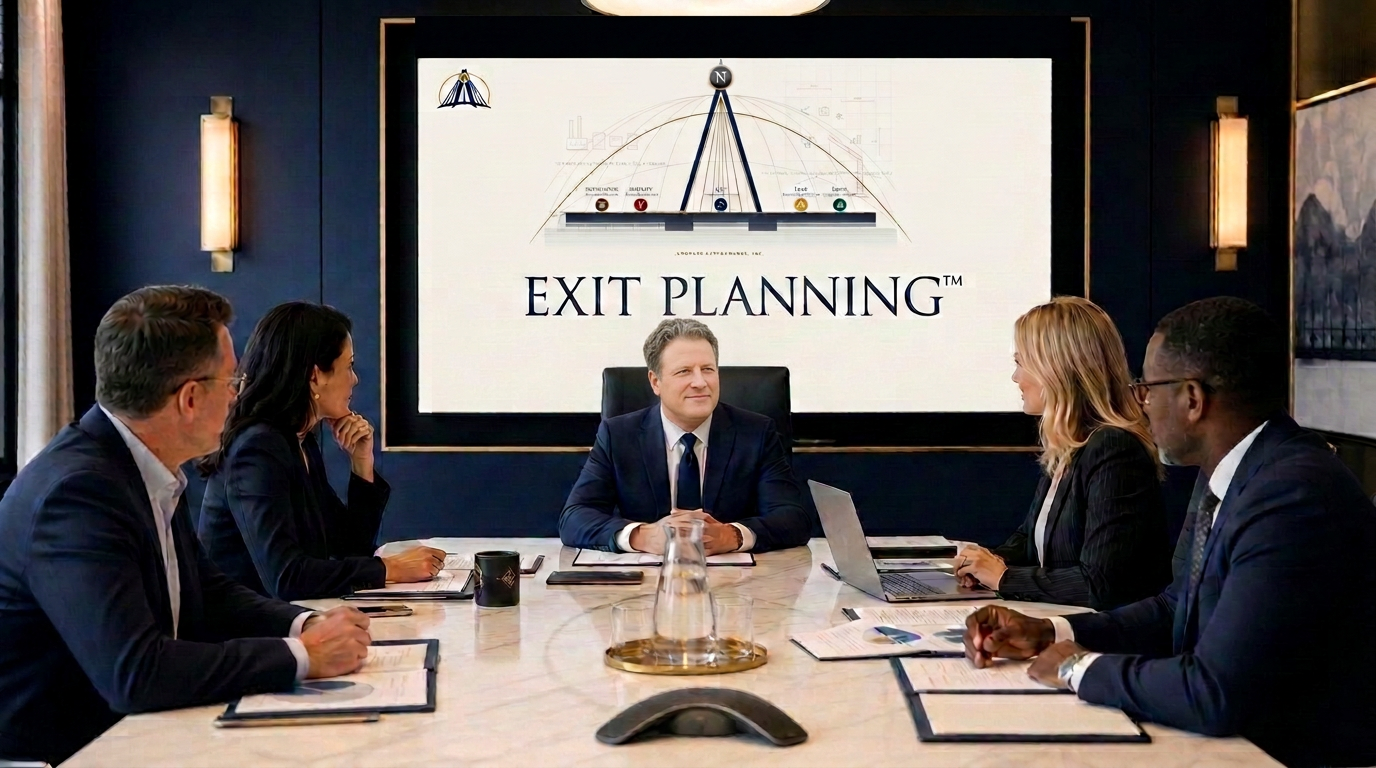
Exit planning is not only about succession. It is the deliberate design of a more valuable, transferable enterprise. The real value lies in the operating system the owner has built: the decisions, relationships, standards and disciplines that produce results independent of any one person. That is the organization's secret sauce — a proprietary advantage competitors cannot buy, see or copy.
The work creates value even if the owner never sells: reduced dependency, stronger leadership, improved financial control, replicable systems and strategic clarity. Those are the conditions of a durable enterprise. A transaction, if it ever comes, simply reveals whether the architecture was built.
The desired end state is a business that is transferable, valuable and independent of its owner — with the owner prepared for the transition through structure, succession and legacy planning.
Process
Select a stage to see only the suppliers, inputs, outputs and beneficiaries that are live at that point in the work.
Use the arrow keys to move between stages, Enter or Space to select one, and Escape to return to the full SIPOC.
Full SIPOC
All seven stages shown. The architecture is one process; the stage view narrows it without changing it.
Your wording
Restate the suppliers, inputs, outputs and beneficiaries in your own language.
Who provides what the work needs
What comes in
What comes out
Who receives it
Take it with you
A one-page sheet of the full SIPOC, with your own wording.
The objective is not to complete a transaction. It is to create a stronger, more transferable enterprise while expanding the owner’s options.
Owner readiness
Goals, timing, identity, emotional readiness and life after ownership.
Enterprise readiness
Systems, operating discipline, owner independence and transferability.
Financial readiness
Financial quality, cash flow, reporting, concentration and value drivers.
Leadership & succession readiness
Leadership depth, decision capability, successor development and continuity.
Market readiness
Industry conditions, buyer attractiveness and timing.
Transition readiness
Advisory team, legal and tax coordination, transaction options and implementation.
Current State → Architected State
Exit readiness is not a date. It is a condition, read through six lenses. This is the pattern of movement the architecture produces — and the discipline that carries each one.
| Current state | The six readiness lenses | Architected state |
|---|---|---|
| Higher risk. Lower transferability. More dependency. | Lower risk. Higher transferability. Built to perform. | |
| Material gap: The owner is the bottleneck.Decisions, relationships and exceptions route back to one person. | 01 · Owner dependencyHow much of the business runs because of the owner. | Architected: The leadership team decides.Decision rights are assigned, and the business performs without the owner in the room.FOUNDATION™ · Owner intent, governance and decision-rights architecture. |
| Partial: The bench is thin.Key roles have no tested second, and successor readiness is assumed rather than evidenced. | 02 · Leadership depthWhether there is capable leadership at every level that matters. | Architected: Depth and a named pathway.Roles, development and readiness are on a dated pathway, tested through real decisions.LEAD™ · Authority transfer, successor development and executive cadence. |
| Material gap: The work is undocumented.Results depend on who is on shift; process lives in people, not in the system. | 03 · Operating disciplineWhether the work is consistent, repeatable and owned. | Architected: The process drives the result.Simplified, standardized work with named owners and a visible operating cadence.SIMPLIFY™ · Value-stream design, role clarity and complexity removal. |
| Partial: Reporting looks backwards.Figures arrive late, margin is read at the total, and forward insight is thin. | 04 · Financial visibilityWhether the numbers are timely enough to decide on. | Architected: Decision-quality data.Trusted reporting, a scorecard with owners, and forecasts a successor or buyer can rely on.SIMPLIFY™ · Scorecard architecture, measure pairs and financial control routines. |
| Partial: Growth is not systematized.The model works but cannot be handed over; it travels with the founder. | 05 · Growth transferabilityWhether growth can be repeated by someone else. | Architected: A repeatable growth engine.Documented model, offer and motion that a new leader can run and scale.GROW™ · Market focus, capability investment and repeatable go-to-market design. |
| Material gap: Options are limited.Concentration, key-person risk and diligence gaps narrow the paths available. | 06 · Market & transition readinessWhether the enterprise is ready to be led by whoever comes next. | Architected: More paths, fewer surprises.Risk reduced, evidence assembled, and the transition architecture coordinated with the advisory team.ARC™ · Readiness review, gap closure and the owner's decision calendar. |
This is a pattern of movement across founder-exit engagements, not a single client result. Client-reported figures, with the architecture that produced them, are held in the record of engagements and shared in an executive conversation.
Architecture → Intervention → Result
Industrial manufacturer
On-time delivery
82%96%
+14 pts · 12 months
Present-reality read, decision rights redesign, one executive operating cadence with owners, dates, and evidence.
Multi-site professional services firm
Gross margin
31%39%
+8 pts · 18 months
80/20 concentration read across clients, services, and initiatives; portfolio exit plan; capacity reallocated to the highest-contribution work.
Family enterprise
Roles with a ready-now successor
1 of 76 of 7
+5 roles · 24 months
Successor readiness assessment, governance and decision-rights build, development plan against the future role, renewal cadence to protect the second curve.
Client names are withheld under confidentiality. Figures are client-reported over the stated window. The full record is walked through in an executive conversation.
Succession is built, not announced
Succession is the deliberate transfer of leadership, capability, relationships and enterprise value. Executive search is the final option, never the starting point.
01
Reduce founder dependence
Transfer decisions, relationships, governance and knowledge out of the founder's hands and into the organization.
02
Develop & test successors
Build capability through real P&L, strategic and organizational responsibility — decisions, not simulations.
03
Confirm or recruit
Select the internal successor, or move to an external search only when the internal path genuinely closes.
Exit planning runs through the Operating System
FOUNDATION™
Owner intent, governance, trust and readiness.
SIMPLIFY™
Clarify roles, decision rights, complexity and economic priorities.
LEAD™
Build leadership depth, transfer authority and strengthen execution.
GROW™
Prepare the organization and successor for the next growth curve.
ARC™
Review readiness, close gaps and adjust the transition path.
How ready is your business to transition?
Understand owner dependency, leadership depth, enterprise transferability, financial readiness and transition risk before deciding what comes next.
Step 01 · Establish the evidence
The Exit Readiness Score scores owner dependency, leadership depth, transferability, financial readiness and transition risk.
Take the Exit Readiness Score →Step 02 · Read the results together
Bring the score into a confidential conversation. The form arrives pre-framed around exit readiness, so you only add what the score cannot show.
Begin the conversation with Steve →Compass serves as the architect and integrator of the readiness and transition process. We bring together the specialists an owner actually needs — valuation, investment choices, legal strategy, tax strategy, wealth and transaction expertise — so the team operates from one plan instead of separate agendas.
The Exit Planning Advisory — typically four or five people around the table
Business Owner / Entrepreneur
The center of the decision. Defines goals, timing, legacy intent and the non-negotiables that shape every option.
Compass Exit Planning Architect
Engagement lead. Owns the readiness architecture, the sequence and the owner's decision calendar.
Valuation & Financial Advisor
Quantifies enterprise value, value drivers and investment or transaction-structure alternatives.
Legal & Tax Strategist
Designs entity structure, governance, risk protection and the tax-efficient architecture of the transition.
Wealth & Legacy Advisor
Aligns the transition with family, estate, philanthropic and post-transition capital objectives.
These are engagement positions, not headcount. On a smaller engagement one Compass architect carries several of them; the accountability for each remains named. The owner remains the decision-maker at the center of the table.
Evidence
Compass separates the succession decision from the transition architecture, because the second one is where the value is kept or lost. Published figures on undesigned handovers are cited beneath each reading as support.
A promotion is a change of architecture, not a change of title. Compass writes the new role's decisions, cadence and measures before the appointment, so the first ninety days are an installation rather than an improvisation.
Supporting evidence
~60% Of leaders moving from individual contributor to people leader, nearly 60% report receiving little to no formal preparation for that shift — and when development is offered, it typically emphasizes process over relational capability.
Succession Architecture™ is built on that distinction. Naming a successor is a decision; transferring the wisdom, the stakeholder relationships and the operating discipline is the architecture that determines whether the decision holds.
Supporting evidence
$1 trillion Organizations lose an estimated $1 trillion annually through failed or poorly managed leadership transitions. Most organizations focus on who leads next while underinvesting in how the transition happens.
Onboarding is therefore designed, not welcomed. Cross-boundary introductions, named stakeholders and a first-quarter cadence are part of the requisition, not an afterthought once the offer is signed.
Supporting evidence
The report's network research shows that new hires typically begin as peripheral players in the organizational network, and without intentional design it can take months before they build the relationships needed to get things done.
How to read this band: every reading above is Compass's own interpretation, written from Compass engagements and the Compass Enterprise Operating Architecture. The published figures beneath each reading are supporting evidence only — they are cited to test the reading, not to make the argument, and none of them was produced for or with Compass.
Full citation: Center for Creative Leadership, “The Space Between People: Building the Human Connections That Make Leadership Work at Scale,” Challenge Report CS4647. © Center for Creative Leadership. All rights reserved. ccl.org
Common questions
Every path starts with the same question: is the enterprise ready to transfer? The architecture is the same; only the destination changes.
The next step
Whether the transition is two years away or ten, the strongest time to improve transferability, leadership depth and enterprise value is before urgency dictates the choices.
Step 01 · Establish the evidence
The Exit Readiness Score scores owner dependency, leadership depth, transferability, financial readiness and transition risk.
Take the Exit Readiness Score →Step 02 · Read the results together
Bring the score into a confidential conversation. The form arrives pre-framed around exit readiness, so you only add what the score cannot show.
Begin the conversation with Steve →Not sure where to start?
Under a minute. From this page, most leaders begin with The organization.